


Senergy Direct explains how to work out the right number of solar panels for your home – and why the answer is different for every property.
It is the first question almost everyone asks when they start thinking about solar panels: how many do I need? It sounds like it should have a simple answer — a number you can look up in a table or calculate in thirty seconds. And whilst there are useful rules of thumb that give a sensible starting point, the honest answer is that the right number of panels is specific to your home, your consumption, your roof, and your plans for the future.
The number of solar panels your home needs is determined by how much electricity you use, how much of your roof is available and appropriately oriented, how much shading affects your roof across the year, what wattage of panels you choose, and whether you are sizing for today’s demand or planning ahead for an electric vehicle or heat pump. Change any of these inputs and the panel count changes with it.
In this guide, Senergy Direct walks you through every factor that feeds into a solar panel count – with real numbers, worked examples, and a practical reference guide by property size. By the end, you will understand why the question has a different answer for every home, and you will have the tools to make sense of the recommendation when an installer gives you one.
In This Guide We Answer:
- Why “How Many Panels Do I Need?” Is the Right Question – But Not the Only One
- Start Here: How Your Annual Electricity Consumption Determines Your System Size
- From Consumption to Panel Count – How the Numbers Actually Work
- How Roof Orientation, Pitch, and Shading Affect How Many Panels You Need
- How Much Roof Space Do You Actually Need — and What If Yours Is Limited?
- Does Where You Live in the UK Affect How Many Panels You Need?
- How Panel Wattage and Efficiency Change the Panel Count for the Same System Size
- Should You Size for Today’s Consumption — or Plan for an EV, Heat Pump, or Battery?
- Typical Panel Counts by Property Size — a Practical Reference Guide for UK Homes
- How Senergy Direct Works Out the Right Number of Panels for Your Specific Home
1. Why “How Many Panels Do I Need?” Is the Right Question – But Not the Only One
When people start researching solar panels, the number of panels is usually the first thing they want to know. It is a natural instinct – it feels like a concrete, manageable figure that anchors the whole decision. But the number of panels is not really the starting point; it is the end result of a calculation that begins with your home’s electricity consumption, runs through your roof’s characteristics, and arrives at the panel count only once the system size has been properly established.
That ordering matters, because working backwards from a fixed panel count — “I want ten panels, what will they generate?” – often leads to a system that is poorly matched to your actual needs. A household that installs ten panels because they look right on the roof, without first establishing whether a ten-panel system covers their consumption, may find themselves generating more electricity than they can use in summer and still relying heavily on the grid in winter.
This guide from Senergy Direct works through the question properly – starting with consumption, working through the key variables of roof orientation, shading, panel wattage, and location, and arriving at panel count as a conclusion rather than a starting assumption. It also explains why your answer is personal to your home and why a number quoted as typical for a “three-bedroom house” may or may not apply to yours.
| Senergy Tip | Before requesting any solar quotes, gather two pieces of information: your annual electricity consumption in kWh (from your energy bill or supplier app) and the orientation of your main roof slope (south, east, west, or a combination). These two data points allow Senergy Direct to give you a meaningful initial sizing estimate in the first conversation – saving time for everyone. |
2. Start Here: How Your Annual Electricity Consumption Determines Your System Size
Annual electricity consumption is the single most important input in working out how many solar panels your home needs. Everything else – roof orientation, shading, panel efficiency, location – adjusts the calculation around this central figure. Get the consumption number right, and the rest follows logically.
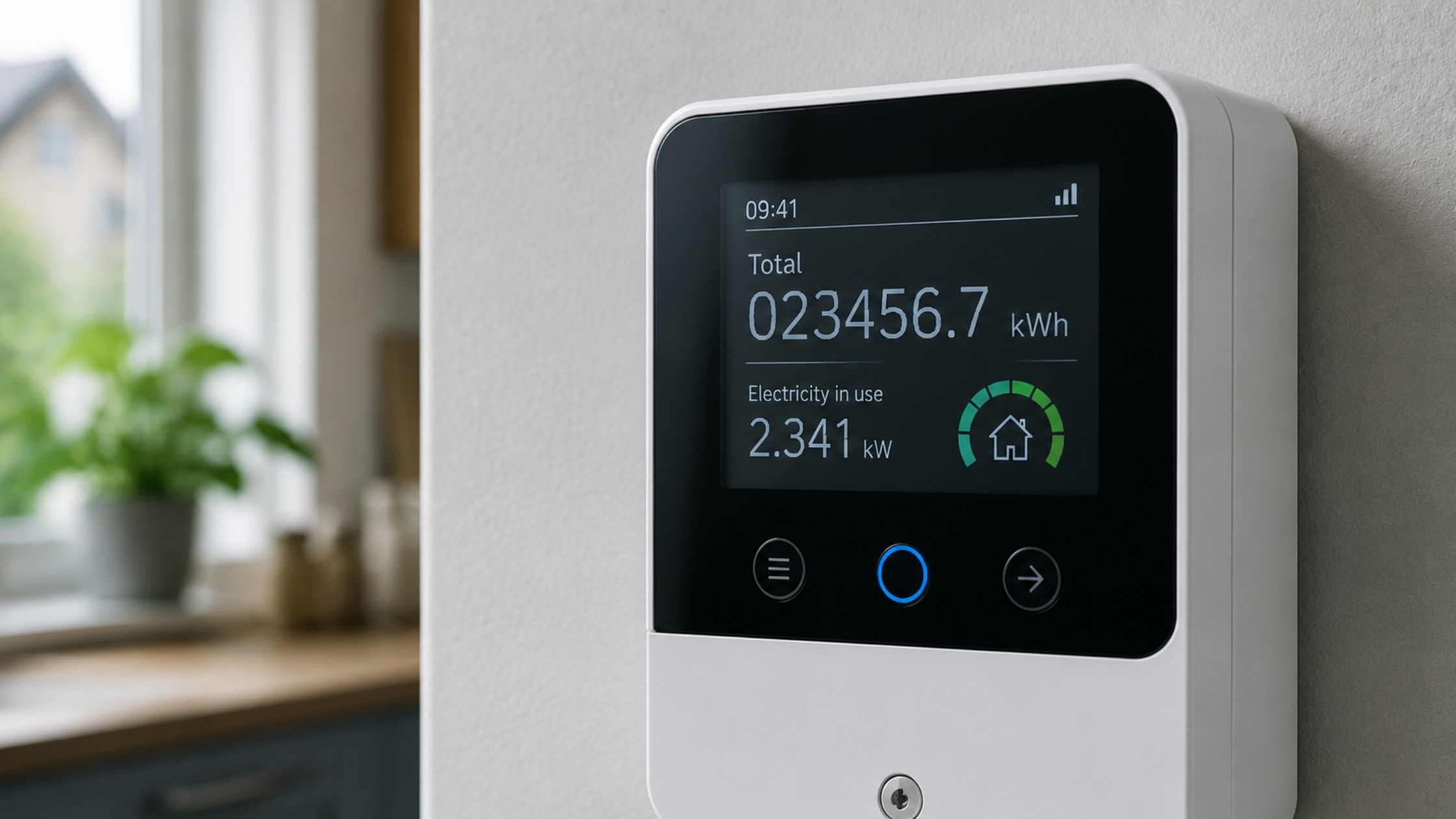
Your annual consumption in kilowatt hours (kWh) is printed on your electricity bill, shown in your energy supplier’s app, or readable from your smart meter. The average UK household currently consumes around 2,700–3,100 kWh per year, though this figure varies enormously depending on household size, heating type, and whether an electric vehicle or heat pump is in use. A couple in a two-bedroom flat with gas heating and cooking might use 1,500–2,000 kWh per year. A family of four in a four-bedroom detached house with an EV could easily exceed 6,000 kWh.
From Consumption to System Size
In the UK, a solar installation typically generates between 850 and 1,100 kWh per kilowatt peak (kWp) of installed capacity per year, depending on location and roof orientation. Using the midpoint of 950 kWh/kWp as a working figure, a household consuming 3,000 kWh per year needs a system of approximately 3,000 ÷ 950 = 3.16 kWp to generate electricity equivalent to its annual consumption. Rounded up to the nearest standard system size, that points towards a 3.5–4kWp installation.
It is important to note that generating electricity equivalent to your annual consumption does not mean you will be self-sufficient. Solar panels generate electricity when the sun shines — predominantly during daytime hours and more abundantly in summer than in winter. You will still use grid electricity in the evenings and overnight, and you will export surplus solar electricity during sunny summer days. Battery storage addresses this mismatch, but even without it, a well-sized solar system significantly reduces your annual grid consumption and electricity bill.
Why Consumption Is More Important Than Household Size
The number of bedrooms in your home is a very rough proxy for electricity consumption – it is the figure most commonly used in “how many panels do I need?” tables because it is the one piece of information people readily know. But two three-bedroom houses can have wildly different electricity consumption depending on how many people live in them, whether they work from home, whether they have an EV, and whether their heating is gas or electric. Always use your actual annual consumption figure rather than a bedroom-based estimate where possible.
| Senergy Tip | If you cannot find your annual consumption figure, look for your monthly electricity usage on recent bills and multiply by twelve. Alternatively, if you have a smart meter with an IHD (in-home display), it will show your daily or weekly consumption — multiply up to get an annual estimate. Even a rough figure is more useful than a bedroom count for sizing purposes. |
3. From Consumption to Panel Count – How the Numbers Actually Work
Once you have established the right system size in kWp, converting that to a panel count is straightforward – though the answer depends on the wattage of the panels being specified. Modern residential solar panels in the UK are typically rated between 400W and 500W per panel, with 450W panels increasingly common as the residential standard in 2026.
The formula is simple: panel count = system size in watts ÷ individual panel wattage. For a 4,000W (4kWp) system using 400W panels, that is 4,000 ÷ 400 = 10 panels. With 450W panels, the same 4kWp system needs 4,000 ÷ 450 = 8.9 panels — rounded up to 9. With 500W panels, 4,000 ÷ 500 = 8 panels exactly. The system size in kWp is what determines how much electricity the installation generates; the individual panel wattage determines how many panels are needed to reach that system size.
A Worked Example
Take a three-bedroom household in the East Midlands consuming 3,200 kWh per year. At a local generation rate of 950 kWh/kWp, they need a system of approximately 3.37 kWp. Rounding up to 3.5 kWp as the nearest practical system size, and using 450W panels: 3,500 ÷ 450 = 7.8 panels, rounded up to 8. Eight panels at 450W gives a 3.6 kWp system, generating approximately 3,420 kWh per year — a close match to annual consumption.
If the same household upgraded to 500W panels: 3,500 ÷ 500 = 7 panels for a 3.5 kWp system. The higher-wattage panels deliver the same system output with one fewer panel — useful if roof space is limited. In practice, most households with this consumption profile end up with 8–10 panels, depending on the exact panel wattage and whether the system is sized precisely to annual consumption or slightly above it to maximise generation and export income.
Why Systems Are Often Slightly Oversized
Many solar systems are deliberately sized slightly above the household’s current annual consumption, for several reasons. First, any surplus electricity can be exported to the grid under the Smart Export Guarantee, earning a payment rather than being wasted. Second, panel output degrades gradually over time — a system that closely matches consumption today will fall slightly short in ten years. Third, electricity demand commonly rises over a household’s lifetime as new appliances, EVs, or heat pumps are added. Senergy Direct models both a tight-fit system and a slightly oversized option for every customer, presenting the trade-offs clearly.
| Senergy Tip | When an installer quotes you a panel count without specifying the wattage of each panel, the number alone tells you very little about the system’s output. Always ask for the total system capacity in kWp alongside the panel count – that is the figure that determines how much electricity the system generates, and therefore how much it saves you. |
4. How Roof Orientation, Pitch, and Shading Affect How Many Panels You Need
Two homes with identical electricity consumption can need different numbers of panels if their roofs face different directions or receive different levels of shading. Roof characteristics are the most significant site-specific factor in panel count, and they explain why the same consumption figure can lead to different system size recommendations for different properties.
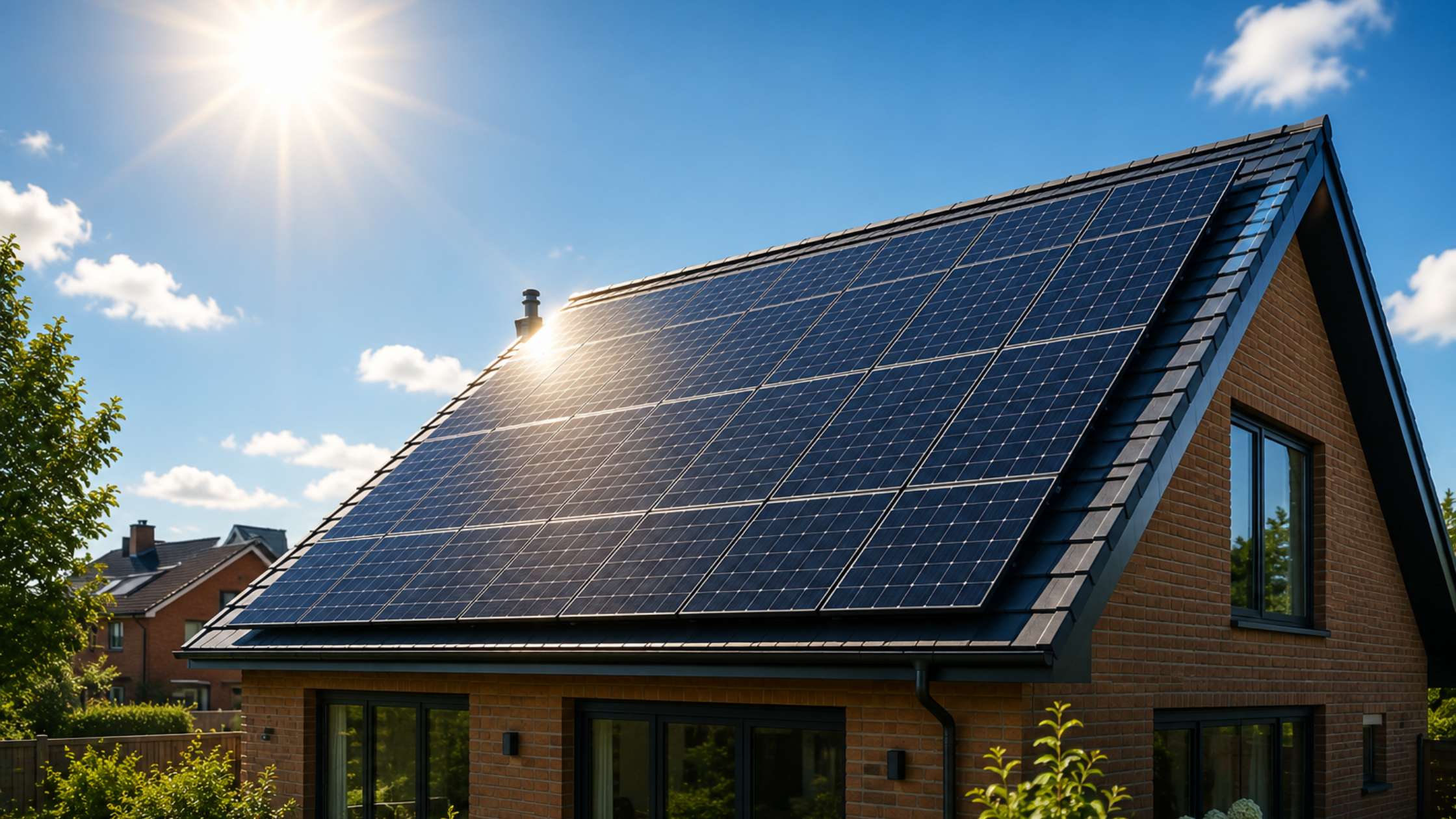
In the UK, a south-facing roof at a pitch of around 30–40 degrees is the optimal configuration for annual solar energy capture. Panels on such a roof receive the maximum amount of solar radiation across the year and are used as the benchmark for generation estimates. East- or west-facing roofs receive less direct radiation than south-facing ones, typically generating around 15–20% less per kWp of installed capacity on a single-aspect installation.
The Impact of Orientation on Panel Count
If a south-facing 4kWp system meets a household’s needs, an east- or west-facing system of the same rated capacity would generate approximately 15–20% less electricity. To achieve the same annual generation as the south-facing system, the east- or west-facing installation would need to be sized up by roughly the same proportion — perhaps 4.7–5kWp rather than 4kWp. That typically means one or two additional panels. Many households with east- or west-facing roofs install panels on both aspects simultaneously, splitting the array across two roof slopes to broaden the generation window across morning and afternoon.
Pitch: the Angle of the Roof
Roof pitch also affects generation, though the impact is less dramatic than orientation. The optimal pitch for UK solar is approximately 30–40 degrees — close to the pitch of most standard UK pitched roofs, which is fortunate. Shallower pitches (below 15 degrees) and steeper pitches (above 50 degrees) both reduce annual generation somewhat. Flat roofs can be addressed with angled mounting frames that tilt panels to an appropriate angle, adding hardware cost but restoring generation efficiency.
Shading: the Most Significant Performance Reducer
Shading — from chimneys, trees, neighbouring buildings, dormer windows, or roof vents — can significantly reduce the output of a solar installation, particularly where string inverters are used. With a string inverter, shading on even one panel reduces the output of the entire string connected to it. For roofs with meaningful shading, the choice of inverter technology (microinverters or power optimisers) can largely mitigate this effect by allowing each panel to operate independently. However, where shading is severe and unavoidable, more panels may be needed to achieve target annual generation — or the system design may need to exclude the most heavily shaded sections of roof entirely.
| Senergy Tip | During your Senergy Direct site survey, the surveyor will assess shading at different times of day and across different seasons using specialist tools, not just a visual inspection. Shading that looks minor from the ground can have a disproportionate impact on system performance, particularly in the mornings and evenings when the sun is lower. An accurate shading assessment is one of the most valuable things a professional site survey delivers. |
5. How Much Roof Space Do You Actually Need — and What If Yours Is Limited?
Panel count and roof space are closely linked — more panels require more roof area, and the amount of usable roof space available on your property may constrain the maximum system size you can install regardless of your consumption. Understanding how much space solar panels actually require helps you assess whether your roof can accommodate the system size your consumption suggests.
A modern residential solar panel — typically around 1.7m by 1.1m in physical dimensions — occupies approximately 1.9 square metres of roof area. When installed, panels need a small gap between each other (around 3cm) and a clearance from the roof edge (typically 30–40cm on all sides) for safety, airflow, and structural reasons. A 10-panel installation covering around 20–22 square metres of roof area is the practical minimum space requirement for a system of that size.
Typical Space Requirements by System Size
As a practical guide: a 6-panel system (approximately 2.7kWp at 450W per panel) requires around 12–14 square metres of usable roof space. An 8-panel system (3.6kWp) needs around 16–18 square metres. A 10-panel system (4.5kWp) needs around 20–22 square metres. A 12-panel system (5.4kWp) needs around 24–26 square metres. These figures assume a clear, unobstructed roof section — chimneys, skylights, vents, and the roof edge clearance all reduce the usable area from the total roof surface.
What to Do If Your Roof Space Is Limited
If your roof cannot accommodate the number of panels your consumption suggests, there are two practical responses. The first is to specify higher-wattage, higher-efficiency panels – panels rated at 480W or 500W rather than 400W or 420W deliver more power from the same roof area, allowing a smaller panel count to achieve a similar system output. The second is to accept a smaller system than your consumption ideally requires, sizing it for what the roof can accommodate and accepting that it will meet a proportion of your annual consumption rather than all of it.
Neither of these responses is a failure — a smaller system that covers 60% of your annual electricity consumption still delivers substantial savings and a strong return on investment. Senergy Direct always presents realistic options based on actual available roof space, rather than proposing a system that looks good on paper but cannot fit on the roof.
Roof Obstructions and Usable Area
Chimneys, skylights, velux windows, soil pipes, satellite dishes, and dormer sections all reduce the usable area of a roof. On some properties — particularly Victorian terraces and older semi-detached houses — these obstructions can significantly constrain the practical panel count even where the overall roof area looks generous from the street. The only way to establish an accurate usable area is a professional site survey that assesses the actual roof layout and identifies every obstruction.
| Senergy Tip | If you are unsure how much usable roof space you have, a reasonable approximation can be made from Google Maps satellite view – look at your roof from above, estimate its dimensions, and subtract any obvious obstructions. Share this estimate with Senergy Direct when you first make contact and they can give you a preliminary view of how many panels are likely to be feasible before the site survey confirms the detail. |
6. Does Where You Live in the UK Affect How Many Panels You Need?
Location within the UK has a genuine but often overstated effect on solar panel performance. The variation in solar irradiance across the country is meaningful — the south-west of England receives significantly more solar energy per year than the north of Scotland — but it does not make solar panels unviable anywhere in the UK, and it does not change the fundamental approach to sizing.
The key figure is annual solar irradiance — the total amount of solar energy available at a given location per square metre of roof surface per year, measured in kilowatt hours per square metre (kWh/m²). In the UK, this ranges from approximately 900–1,100 kWh/m² per year in the sunniest parts of the south coast to around 800–900 kWh/m² per year in Scotland and the north of England.
How Location Affects Panel Count
The practical implication of this variation is that a household in Aberdeen needs a slightly larger system than an identical household in Essex to generate the same annual electricity output. Using round numbers: a household consuming 3,000 kWh per year in Exeter might need a 3kWp system (at 1,000 kWh/kWp annual yield). The same household in Aberdeen, where the annual yield might be 850 kWh/kWp, would need a 3.53kWp system to generate the same 3,000 kWh — perhaps one or two additional panels.
This difference is real but modest. For most UK households, the location adjustment amounts to one or two panels compared to the national average, not a fundamental difference in system viability. Senergy Direct uses site-specific irradiance data for every property they survey — not national averages — ensuring the panel count recommendation reflects the actual solar resource at your specific address.
The Temperature Advantage in the North
There is one climatic factor that partially offsets the lower irradiance of northern UK locations: temperature. Solar panels generate electricity more efficiently at lower temperatures — panel efficiency typically falls by around 0.3–0.5% for every degree Celsius above the standard test temperature of 25°C. In the cooler climate of northern England and Scotland, panels operate closer to their peak efficiency more often, partially compensating for the reduced solar hours. Cool, bright spring and autumn days can produce some of the highest-efficiency generation of the year.
| Senergy Tip | Do not be put off by the assumption that solar does not work well in your part of the UK. Germany — one of the world’s leading solar nations with one of the highest rates of panel installation per capita — receives very similar solar irradiance to most of the UK. Senergy Direct installs systems across the country and will give you a realistic, location-specific generation estimate for your property regardless of where you live. |
7. How Panel Wattage and Efficiency Change the Panel Count for the Same System Size
Panel wattage has increased substantially over the past decade. The residential panels commonly installed in 2015 were typically rated at 250–300W. By 2026, the standard for a quality residential installation has shifted to 430–500W per panel, with some premium products reaching 520W or beyond. This increase in wattage per panel is one of the most significant practical changes in the residential solar market, and it has a direct effect on panel count.
For any given system size in kWp, higher-wattage panels mean fewer panels are needed to reach that capacity. A 4kWp system built with 400W panels requires 10 panels. The same 4kWp system built with 500W panels requires just 8. Fewer panels means less roof space consumed, simpler installation, and — in some cases — lower installation cost, since there are fewer panels to mount and fewer connections to make.
Efficiency Versus Wattage — Understanding the Difference
Panel wattage (the peak power output of a single panel, in watts) and panel efficiency (the proportion of incident sunlight converted to electricity, as a percentage) are related but not identical. A larger-format panel can have a high wattage simply because it has more surface area, even if its efficiency is relatively modest. A smaller panel with very high efficiency can achieve the same wattage in less space. For most domestic roofs, the efficiency rating — how much power the panel produces per square metre — is a more useful metric than raw wattage, because it determines how many panels fit in a given roof area.
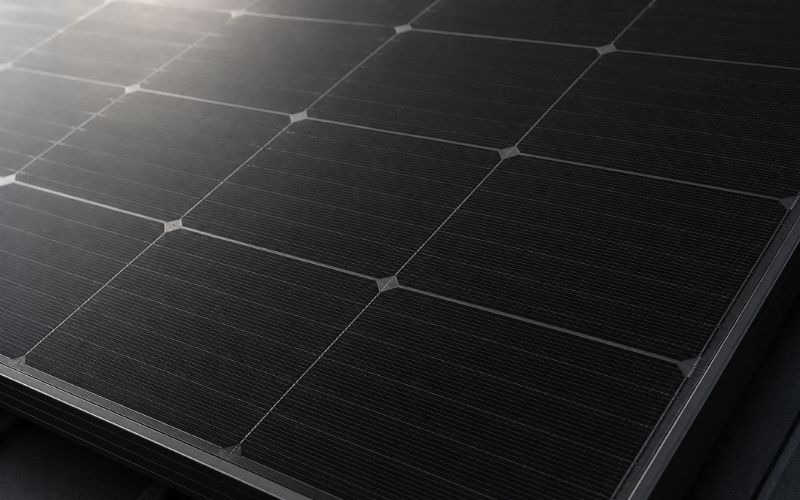
Modern N-Type monocrystalline panels (TOPCon and HJT technologies) achieve efficiencies of 21–23%, compared to 18–20% for older P-Type panels. At 22% efficiency, a panel produces 22% of the solar energy falling on its surface as electrical output. In practical terms, a high-efficiency panel produces more electricity from the same roof area than a lower-efficiency one — meaning fewer panels are needed for the same system output, which is particularly valuable on constrained roofs.
The Low-Light Performance Advantage
Beyond headline efficiency, premium N-Type panels also perform better under the low-irradiance and diffuse light conditions that are characteristic of UK weather. A panel rated at 22% efficiency under standard test conditions (bright sunshine, 25°C) may maintain a higher proportion of that efficiency on overcast days than a cheaper panel rated at the same standard efficiency. This low-light performance advantage is particularly relevant in the UK and is one of the reasons Senergy Direct specifies premium N-Type panels as standard — not just for the efficiency figure, but for the real-world performance advantage in British conditions.
| Senergy Tip | When comparing panel specifications, look for the efficiency rating at low irradiance (sometimes listed as efficiency at 200 W/m²) as well as the standard test condition efficiency. A panel that maintains a higher efficiency under low light will outperform a nominally equivalent panel in UK conditions — and Senergy Direct can explain exactly what the panels they specify deliver on this measure. |
8. Should You Size for Today’s Consumption — or Plan for an EV, Heat Pump, or Battery?
One of the most important — and most frequently underweighted – considerations in solar sizing is future energy demand. A system sized precisely for today’s consumption may be undersized within three to five years if an electric vehicle, air source heat pump, or significant lifestyle change increases the household’s electricity use. Since the highest costs in a solar installation (scaffolding, labour, electrical work) are largely fixed regardless of system size, adding an extra panel or two at the time of installation is significantly cheaper than coming back to expand the system later.
Electric vehicles are the most common driver of future consumption growth. A typical EV used for average UK commuting distances of around 20–25 miles per day requires approximately 5–8 kWh of charging per day. If that charging is done at home — the most cost-effective approach — it adds 1,800–2,900 kWh to annual household electricity consumption. That additional demand may require three to five additional panels to cover from solar.
Heat Pumps and Electrification
Air source heat pumps replace gas boilers as the primary heating system and run on electricity. A typical UK home with an air source heat pump uses an additional 3,000–5,500 kWh of electricity per year for space heating, depending on property size, insulation, and local climate. This can more than double a household’s electricity consumption — transforming a two-person household using 2,500 kWh per year into one consuming 6,000–8,000 kWh. A solar system sized for the pre-heat-pump consumption will cover only a fraction of post-heat-pump demand.
Battery Storage and Its Effect on Sizing
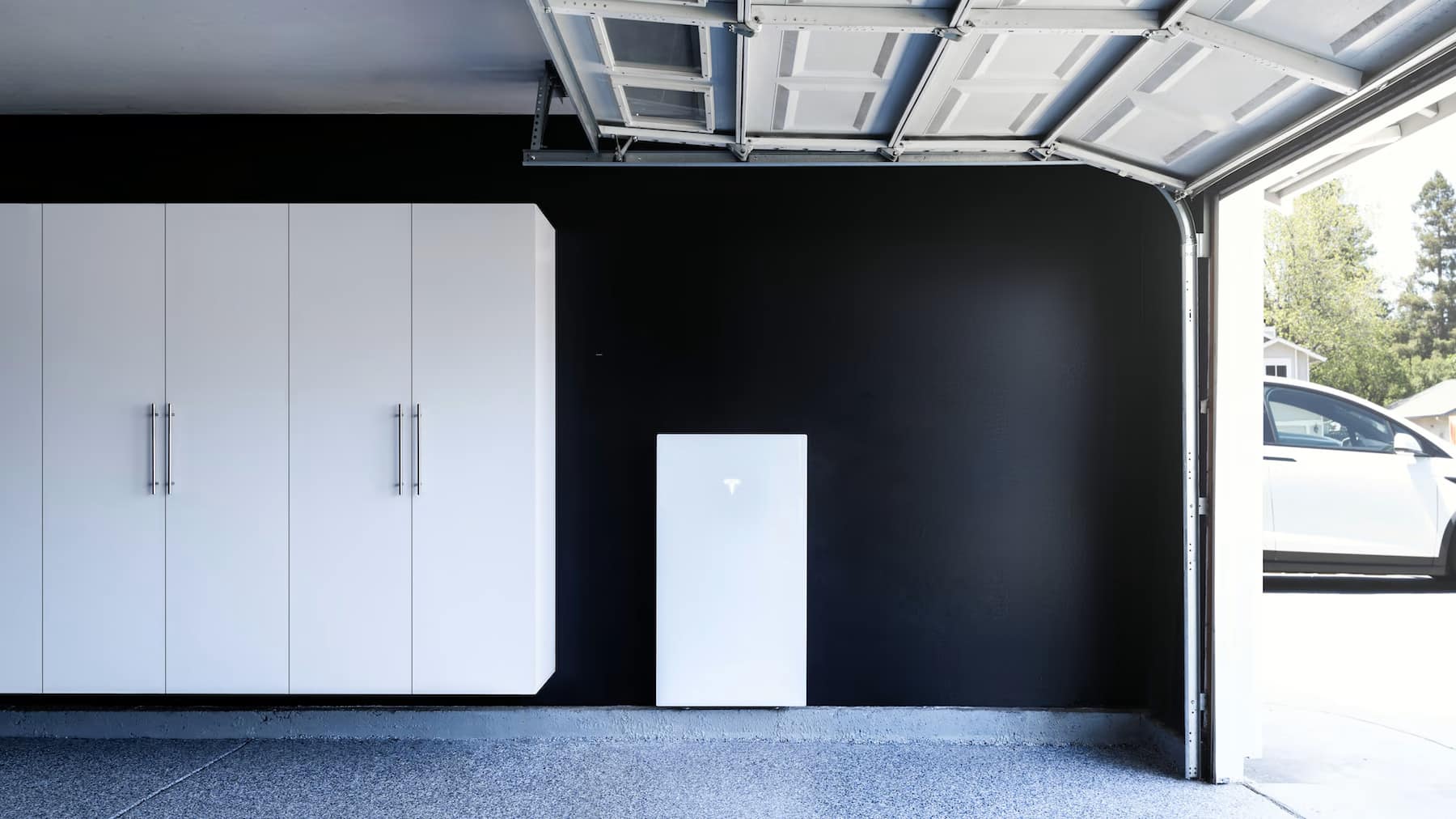
Adding battery storage does not change the number of panels needed to generate a given amount of electricity — the sun provides the same energy regardless of whether a battery is present. What battery storage does is increase the proportion of generated electricity that is self-consumed rather than exported. Without a battery, a household might self-consume 30–40% of its solar generation; with a battery, that rises to 60–80%. This means a battery increases the financial value of each unit generated, which can make a slightly larger solar array more financially worthwhile than it would be without storage.
The Practical Recommendation
Senergy Direct’s standard approach is to size the solar system for current consumption, with an explicit discussion of anticipated future demand. Where an EV purchase or heat pump installation is planned within three to five years, they will model the panel count needed for the post-upgrade consumption and present the cost of sizing up now versus retrofitting additional panels later. In most cases, installing a slightly larger system from the outset is both cheaper overall and simpler in practice.
| Senergy Tip | If you are considering an electric vehicle purchase within five years, tell Senergy Direct at the outset. They will factor the expected additional charging demand into the system sizing and show you the cost of providing for it now rather than later. In most cases, the incremental cost of two or three additional panels at installation is a fraction of the cost of a separate system expansion further down the line. |
9. Typical Panel Counts by Property Size — a Practical Reference Guide for UK Homes
Whilst every home is different and the only truly accurate panel count comes from a site-specific assessment, the following reference guide provides a practical starting point based on typical UK consumption patterns, standard 450W panels, and average UK solar irradiance. These figures assume a gas-heated home with no EV or heat pump, and a south-facing roof at around 35 degrees pitch with no significant shading.
One to Two Bedroom Properties
Annual consumption: approximately 1,500–2,200 kWh. Recommended system size: 2–2.5 kWp. Typical panel count: 5–6 panels at 450W. These smaller systems suit one- to two-person households, flats with south-facing roof access, or properties with limited roof space. They will cover a significant proportion of daytime electricity use and generate meaningful savings, though the absolute saving in pounds per year will be lower than for larger systems due to the smaller generation volume.
Three Bedroom Properties
Annual consumption: approximately 2,500–3,500 kWh. Recommended system size: 3–4 kWp. Typical panel count: 7–10 panels at 450W. The three-bedroom home is the most common property type for solar installation in the UK, and this range represents the sweet spot between system cost, roof footprint, and financial return. A 3.5–4 kWp system on a three-bedroom house typically covers 50–70% of annual electricity consumption and delivers payback in seven to ten years.
Four Bedroom Properties
Annual consumption: approximately 3,500–5,000 kWh. Recommended system size: 4–5.5 kWp. Typical panel count: 9–13 panels at 450W. Four-bedroom homes often have more roof space and higher consumption, making a larger system both feasible and financially attractive. Systems in this range generate substantial annual electricity output and, with battery storage, can achieve very high levels of self-sufficiency in the summer months.
Five Bedroom and Larger Properties
Annual consumption: approximately 4,500–7,000 kWh or more. Recommended system size: 5.5–8 kWp or larger. Typical panel count: 13–18 panels at 450W. Larger properties with higher consumption benefit most from generous roof coverage. Where roof space allows, installing the largest system the roof can accommodate often makes strong financial sense — any surplus generation beyond self-consumption earns Smart Export Guarantee payments rather than being wasted, and the marginal cost of additional panels at the time of installation is low relative to the long-term value they deliver.
| Senergy Tip | These panel count figures are starting points, not firm recommendations. Your actual panel count will be determined by your specific consumption, your roof’s orientation and usable area, any shading present, your choice of panel wattage, and whether you want to size for current or future demand. Senergy Direct produces a site-specific recommendation for every customer — the table above gives you a realistic expectation of the range before the survey confirms the detail. |
10. How Senergy Direct Works Out the Right Number of Panels for Your Specific Home
Working out the right number of solar panels for a specific property is not a calculation that can be done accurately without visiting it. Online calculators, bedroom-based tables, and generic estimates have their place as a first orientation, but they cannot account for the specific shading profile of your roof, the precise usable area after obstructions are mapped, the solar irradiance at your postcode, or the particular consumption pattern of your household. The site survey is where accurate panel count recommendations are made – and it is where Senergy Direct begins every installation project.
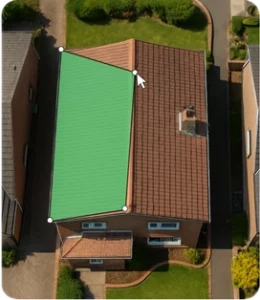 The Senergy Direct site survey covers every factor relevant to system design. The surveyor assesses the roof — its orientation, pitch, condition, available area, and any obstructions or shading sources. They review your electricity consumption from bills or smart meter data. They discuss your plans for EVs, heat pumps, or battery storage. And they use that information, combined with site-specific solar irradiance data, to design a system that is matched to your home and your goals rather than to a generic template.
The System Design Output
The output of the Senergy Direct design process is a system proposal that specifies the number of panels, their wattage and model, the total system capacity in kWp, the predicted annual generation in kWh, the expected annual saving on your electricity bill, and the estimated payback period. This is not a ballpark figure; it is a detailed projection based on your actual property data and consumption, calculated using MCS-accredited methodology and real irradiance data for your location.
Options and Trade-Offs Presented Clearly
Where there are genuine choices to make — between a system sized for current consumption and one sized for future demand, between a compact high-efficiency array and a larger lower-efficiency one, or between installing with or without battery storage — Senergy Direct presents those options with clear financial modelling of each. The goal is to give you the information you need to make a confident decision, not to steer you towards the most expensive option or the one that is simplest to install.
Senergy Direct’s approach reflects a straightforward principle: the right number of panels is the number that makes the most sense for your home, your consumption, your roof, and your budget over a 25-year horizon. That number is different for every property, and finding it accurately is what a professional site survey is for. If you are ready to find out what the right answer is for your home, the conversation starts with a no-obligation survey.
| Senergy Tip | When Senergy Direct provides you with a panel count recommendation, ask them to show you the generation estimate that sits behind it — the predicted annual kWh output of the proposed system. Comparing that figure against your annual consumption tells you what proportion of your electricity the system will cover, which is the most meaningful measure of whether the panel count is right for your home. |
Find Out Exactly How Many Panels Your Home Needs
Senergy Direct designs solar installations for homes and businesses across the UK, starting with a thorough site survey that assesses your roof, your consumption, your location, and your plans — and produces a system recommendation that is specific to your property, not a generic template.
Get in touch with Senergy Direct today for a no-obligation survey and proposal. Find out exactly how many panels your home needs — and how much they could save you every year for the next 25 years.
Frequently Asked Questions
Here are the panel sizing questions Senergy Direct hears most often from homeowners considering solar — with clear, practical answers.
How Many Panels Does the Average UK Home Need?
Most UK homes need between 8 and 13 solar panels, equating to a system of around 3.5–6kWp. A typical three-bedroom house consuming around 2,700–3,100 kWh per year is commonly served by 8–10 panels at 450W each, making up a 3.6–4.5kWp system. However, the right number for your home depends on your actual consumption, roof space, orientation, and any plans for an EV or heat pump — so treat these as indicative starting points rather than definitive recommendations.
Can I Install Solar Panels If My Roof Faces East or West Rather Than South?
Yes, absolutely. East- and west-facing roofs generate around 15–20% less electricity per kWp of installed capacity than a south-facing equivalent, but they are perfectly viable for solar installation. Many households install panels on both the east and west slopes simultaneously, which broadens the generation window across the day and can actually produce a more useful generation profile for morning and evening consumption. Senergy Direct designs east-west systems regularly and will confirm the expected generation for your specific roof.
What Is the Minimum Number of Panels Worth Installing?
There is no hard minimum, but systems of fewer than 4–6 panels (around 1.8–2.7kWp) tend to offer a longer payback period relative to larger systems because the fixed costs of installation — scaffolding, labour, MCS certification — are similar regardless of panel count. For most UK properties, a system of at least 6–8 panels delivers a strong financial return. Senergy Direct will advise honestly if the available roof space is too limited to make solar worthwhile.
Do I Need Planning Permission to Install Solar Panels?
For most UK properties, solar panels fall within permitted development rights and do not require planning permission. Exceptions include listed buildings, properties in conservation areas, and some other planning-sensitive locations, where prior approval may be needed. Senergy Direct confirms planning status for every installation as part of the pre-installation process and will manage any required applications on your behalf.
Can I Add More Panels to My System After It Has Been Installed?
It is possible to expand a solar system after installation, but it is more complicated and expensive than installing the right-sized system from the outset. Expanding may require upgrading the inverter, additional DNO notification, and a further scaffolding visit. Where future expansion is anticipated, Senergy Direct recommends either installing a larger system initially or choosing an inverter that can accommodate additional panels, making any future expansion simpler and less costly.
How Many Panels Do I Need to Charge an Electric Vehicle?
An EV used for average UK commuting of around 20–25 miles per day requires approximately 5–8 kWh of home charging. To generate that additional electricity from solar, you would need roughly 2–3 additional panels beyond those covering your household consumption, assuming average UK solar conditions. If you are planning an EV purchase, Senergy Direct will incorporate the expected charging demand into the system sizing calculation from the outset.
What Happens If I Generate More Electricity Than I Need?
Any surplus solar electricity that you do not use immediately or store in a battery is exported to the grid. Under the Smart Export Guarantee (SEG), you receive a payment for each unit exported — current SEG rates from leading suppliers range from around 5p to 15p per kWh, with some specialist tariffs paying more. Whilst export rates are lower than the cost of buying electricity, generating surplus that earns SEG payments is far better than undersizing the system to avoid any export.
Will Solar Panels on a North-Facing Roof Generate Enough Electricity to Be Worthwhile?
North-facing roofs receive significantly less solar radiation than south-, east-, or west-facing roofs in the UK and are generally not recommended for solar installation. Output from a north-facing system can be 50–60% lower than an equivalent south-facing installation, which typically makes the financial case marginal at best. If your main roof faces north but you have other roof surfaces facing east, west, or south, Senergy Direct will assess whether panels on those aspects are viable.
How Many Panels Would I Need to Go Completely Off-Grid?
Going completely off-grid in the UK is technically possible but requires a substantially larger system and battery bank than a grid-connected installation. To cover 100% of consumption including winter periods of low solar generation, a typical UK home would need 16–20 panels or more, combined with a battery bank of 30kWh or above to bridge extended low-generation periods. The cost and complexity of a true off-grid system is considerable, and most UK homeowners are better served by a grid-connected system with battery storage that maximises self-sufficiency whilst retaining grid access as a backup.
Does the Number of Panels Affect How Long the Installation Takes?
Modestly, yes. A larger panel array takes longer to mount and wire than a smaller one, but for most domestic installations the variation is a matter of hours rather than days. A standard 8–12 panel installation is typically completed within one to two days once scaffolding is in place. Larger systems of 15 panels or more may take an additional half-day. Installation duration is already factored into the installer’s pricing and is not a variable that changes the overall cost significantly for systems within the normal domestic range.
Disclaimer: This article is intended for general informational purposes only. All panel counts, system sizes, generation figures, and consumption estimates are illustrative and based on typical UK conditions at the time of writing. Actual system requirements will vary depending on your specific property, location, roof characteristics, consumption, and equipment choices. Always obtain a site-specific assessment from a qualified MCS-certified installer before making any purchasing decision. Senergy Direct accepts no liability for actions taken or not taken based on the contents of this article.

