


Everything Essex homeowners need to know about the government’s new low and zero-interest Warm Homes Loan Scheme — and how Senergy Direct can help you use it to install solar panels and battery storage with nothing to pay upfront.
Energy bills have dominated household budgets for years, and for many homeowners the obvious answer — generating and storing your own electricity — has always come with one big obstacle: the upfront cost. That obstacle has just got a lot smaller.
On 27 October 2026, the government launched the Warm Homes Loan Scheme, the finance arm of its £15 billion Warm Homes Plan. It allows homeowners right across the UK to borrow for solar panels and home batteries at low or even zero interest, with no upfront payment and no income limit.
With rates this low, many households could find that their monthly repayment is smaller than the saving on their energy bill — meaning they pay less from the very first month while paying off a system they will own. In this guide, we answer the questions we are hearing most from homeowners across Essex, Kent and Suffolk.
In This Guide We Answer:
- What Exactly Is the Warm Homes Scheme?
- Who Is Eligible for the Warm Homes Loan Scheme?
- How Much Can I Borrow for Solar Panels and a Battery?
- What Interest Rate Will I Actually Pay — Is It Really 0%?
- Could My Repayments Be Lower Than My Current Energy Bill?
- How Do Solar Panels and a Battery Actually Cut My Bills?
- Is It a Grant — and How Does It Differ From Other “Warm Homes” Schemes?
- What Are the Rules on Installers and Quotes?
- Are There Any Risks or Things I Should Check First?
- How Do I Apply — and How Can Senergy Direct Help?
1. What Exactly Is the Warm Homes Scheme?
When people talk about the “Warm Homes Scheme”, they usually mean one of two things. The first is the Warm Homes Plan, the government’s £15 billion programme, published in January 2026, to upgrade up to five million UK homes by 2030 and triple the number of homes with rooftop solar. The second, and the part that matters most for solar and battery, is the Warm Homes Loan Scheme, which opened on 27 October 2026.
The loan scheme is run by the Department for Energy Security and Net Zero. Rather than lending the money itself, the government pays approved lenders a grant of up to 20% of each loan, and the lender must pass every penny of that on to you as a lower interest rate. The aim is to cut up to around five percentage points off the rate you would normally pay, with some loans offered at 0%.
Put simply: it is a government-backed way to install solar panels and a home battery with nothing to pay upfront, spreading the cost over several years at a much cheaper rate than a standard personal loan.

| Senergy Tip | Searching online? Use the official name, “Warm Homes Loan Scheme“. Several other schemes share the words “Warm Homes” and are easy to mix up — we explain the difference in question 7. |
2. Who Is Eligible for the Warm Homes Loan Scheme?
The good news is that the scheme is deliberately broad. Unlike means-tested support, there is no income threshold, no minimum EPC rating and no restriction on property type at scheme level. It is available right across the UK — England, Scotland, Wales and Northern Ireland.
You can usually apply if you are:
- An owner-occupier of an existing home, with or without a mortgage
- A private landlord borrowing in your own name (not through a limited company)
You will not qualify if:
- The property is still being built — the scheme covers existing homes
- The property is owned by a company
- The same installation is already being funded by another public grant or loan
The one thing to be aware of is that each lender still runs its normal credit and affordability checks. The scheme sets the minimum rules; the lender makes the final lending decision.
| Senergy Tip | If you have a mortgage, that is not a barrier. Most homeowners in Essex who have a mortgage are just as eligible as those who own outright — the lender is simply checking that the monthly repayment is affordable for you. |
3. How Much Can I Borrow for Solar Panels and a Battery?
The scheme sets a maximum loan for each technology, and solar and battery each have their own allowance:
- Solar panels — up to £15,000, including scaffolding, safety equipment, grid connection and additions to an existing array
- Battery storage — up to £15,000, whether fitted alongside new panels or added to an existing solar system
Because the two caps are separate, a typical family home can comfortably fund a complete solar and battery system well within the limits. An EV charger can also be included when it is installed as part of a solar or battery job.
Already have panels? You can use the scheme to add a battery on its own, which is one of the most cost-effective upgrades available to existing solar owners, because it lets you store the energy you currently export cheaply and use it in the evening.
| Senergy Tip | Solar panels and batteries for homes are currently zero-rated for VAT (until 31 March 2027). Combined with a low-rate loan, that makes now one of the best-value windows there has ever been to install. |
4. What Interest Rate Will I Actually Pay — Is It Really 0%?
There is no single fixed rate. Each participating lender sets its own rate and terms, but the government grant is designed to knock up to around five percentage points off what that lender would normally charge. The government’s own example: a loan that would usually cost 8% could come down to around 3%.
Some lenders are going further and offering 0% interest, particularly on shorter terms for solar and batteries. Because the grant is capped at 20% of the loan, the biggest rate cuts tend to apply to shorter terms, while longer terms (some lenders offer up to 30 years) keep monthly payments lower but usually carry a little more interest.
Ten lenders joined the scheme at launch, with more expected to follow in stages through late 2026 and 2027. The minimum loan length supported by the scheme is three years.
| Senergy Tip | Do not judge a loan on the headline rate alone. The government advises comparing the total amount repayable, the length of the loan and any monthly fees. We will happily walk you through the numbers side by side before you commit to anything. |
5. Could My Repayments Be Lower Than My Current Energy Bill?
For many homeowners, yes — and this is what makes the scheme so exciting. With rates this low, the monthly repayment on a solar and battery system can be smaller than the amount the system knocks off your electricity bill. In other words, you could be paying less each month from day one, while you pay off a system you will own outright.
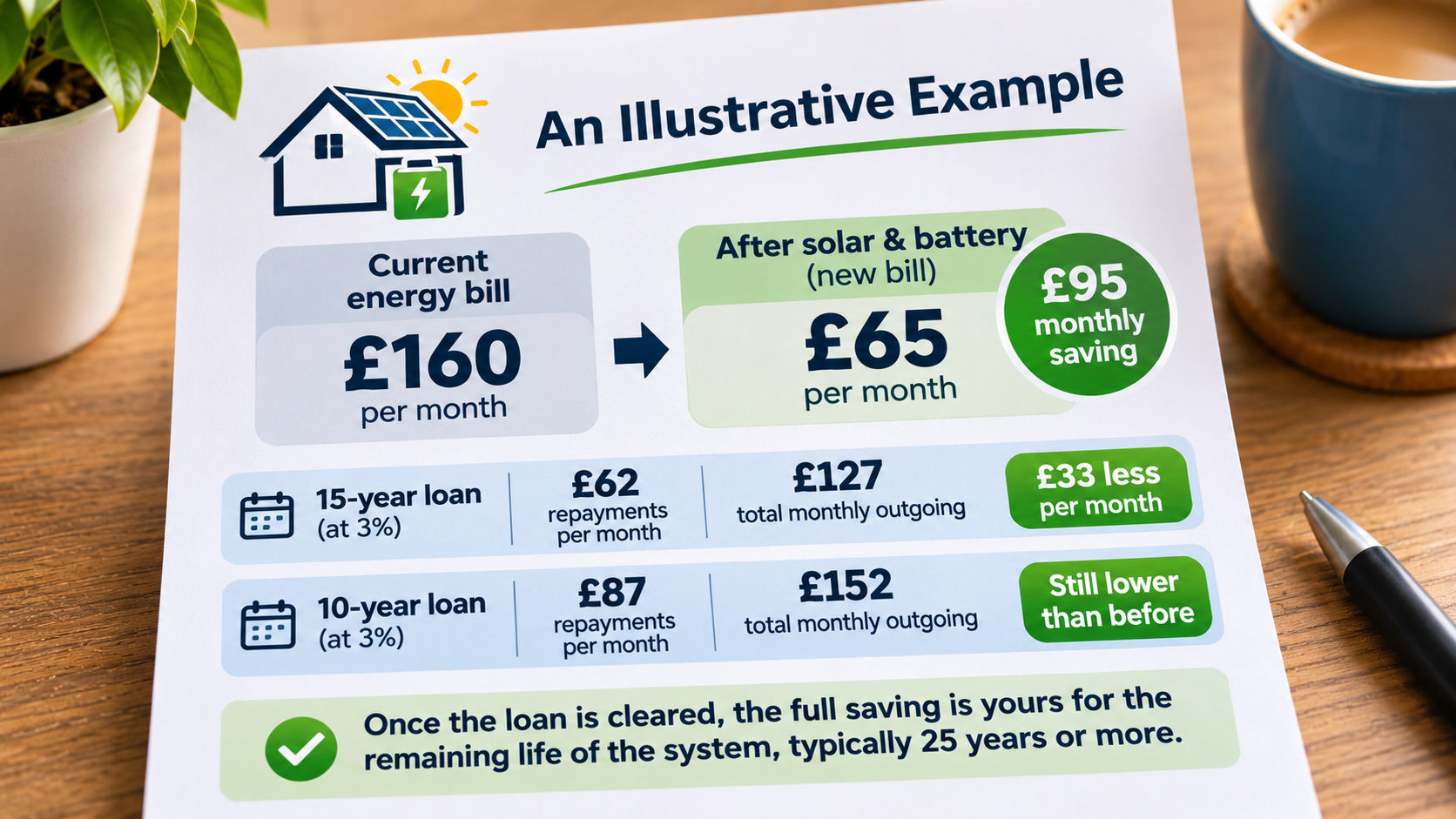
An illustrative example
Imagine a household currently spending £160 a month on electricity, which installs a £9,000 solar and battery system. If the system reduces that bill by around £95 a month, the new bill is roughly £65.
- Over 15 years at 3%: repayments of about £62 a month. Total monthly outgoing ? £127 — around £33 a month less than before.
- Over 10 years at 3%: repayments of about £87 a month. Total outgoing ? £152 — still lower than the original bill, and paid off five years sooner.
Once the loan is cleared, the full saving is yours for the remaining life of the system — and quality panels are typically designed to keep generating for 25 years or more.
The government’s own case studies back this up: one homeowner in Bedfordshire said the finance arrangement left him at least cost-neutral in year one, with the prospect of savings on top.
| Senergy Tip | These figures are illustrative only — every home is different. Your actual savings depend on your usage, roof, system size and tariff. We will give you a personalised projection showing your likely bill saving against your monthly repayment, so you can see the real picture before you decide. |
6. How Do Solar Panels and a Battery Actually Cut My Bills?
Solar panels generate free electricity whenever it is light — yes, even on cloudy Essex days. During the day, your home uses that electricity first, so you buy less from the grid.
Without a battery, any surplus is exported, usually for a modest payment. With a battery, that surplus is stored and used in the evening, exactly when energy demand and prices are at their highest. That is where most households see the biggest jump in savings.
Supercharge it with the right tariff
A battery also lets you take advantage of time-of-use tariffs. In the darker months, when solar output dips, the battery can charge overnight on cheap off-peak electricity and power your home through the expensive peak hours. The government estimates a time-of-use tariff can add around £300 a year on top of the savings from the technology itself.
| Senergy Tip | Ask us about pairing your battery with a smart time-of-use tariff. It is often the single biggest lever on your bill, and it keeps your battery earning its keep through the winter, not just the summer. |
7. Is It a Grant — and How Does It Differ From Other “Warm Homes” Schemes?
The Warm Homes Loan Scheme is a loan, not a grant — you repay it. The government’s money goes to the lender to make your loan cheaper, rather than covering the cost of the installation directly. That is exactly why it is open to almost every homeowner, regardless of income.
A few other schemes use similar names, which causes plenty of confusion:
- Warm Homes Loan Scheme — low and zero-interest loans for solar, batteries and heat pumps, for homeowners on any income
- Warm Homes: Local Grant — funded upgrades for lower-income households, delivered through local councils
- Warm Home Discount — a one-off winter rebate on electricity bills for people on certain benefits
- Boiler Upgrade Scheme — a grant towards heat pumps, which can be combined with the loan
For most working households looking at solar and battery, the loan scheme is the route that applies — and it is available now.
| Senergy Tip | Because there is no waiting list or means test to work through, the loan route is usually far quicker than grant-based schemes. Many homeowners can go from survey to installation in a matter of weeks. |
8. What Are the Rules on Installers and Quotes?
To protect homeowners, every solar and battery installation funded through the scheme must be carried out by an MCS-certified installer, using MCS-certified products, to MCS design and installation standards. The lender checks the installer’s certification at quote stage and again once the job is complete, and the installation must be registered with MCS before the loan completes.
Your quote needs to include:
- A date within the last six months
- Your name and the full installation address
- The installer’s headed paper and MCS number
- An itemised breakdown of every cost
- The system size in kW
Some lenders only work with their own partner installers, while others let you choose any MCS-certified company. It is worth knowing which route you are taking before you start comparing loans.
| Senergy Tip | Every Senergy Direct quote starts with a proper survey of your home and is set out in a clear, itemised format, so you have exactly what a scheme lender will ask for — no chasing paperwork later. |
9. Are There Any Risks or Things I Should Check First?
The scheme is a genuinely positive step, but like any borrowing it pays to go in with your eyes open:
- It is still credit. Missing repayments can affect your credit file, so make sure the monthly payment sits comfortably in your budget.
- Compare the total cost, not just the rate. A longer term lowers the monthly payment but can increase the total you repay.
- Check for fees — arrangement fees or monthly charges can change the picture.
- Funding is finite. The scheme is backed by £300 million of government grant, allocated on a first come, first served basis.
- Beware unrealistic promises. Savings projections should be based on your actual usage and roof, not generic figures.
Keep your quote, finance agreement, invoice, proof of purchase and MCS certificate safe once your installation is complete — the government specifically recommends it.
| Senergy Tip | A trustworthy installer will never pressure you to sign on the day. Take your quote home, look at the numbers, and ask as many questions as you like — that is exactly how we prefer to work. |
10. How Do I Apply — and How Can Senergy Direct Help?
Applying is straightforward, and you apply through a participating lender (directly or via your installer), not to the government:
- 1. Get a survey and quote from an MCS-certified installer.
- 2. Choose your loan — compare rate, term, fees and total repayable.
- 3. Apply — the lender runs its usual credit and affordability checks.
- 4. Get installed — a typical solar and battery installation takes one to two days.
- 5. Start saving — your repayments begin, and so do the lower bills.
Where Senergy Direct comes in
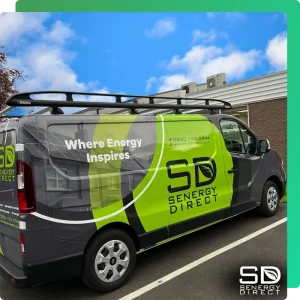
Senergy Direct designs and installs high-performance solar and battery systems for homeowners across Essex, Kent, Suffolk and beyond, fitting premium Aiko solar panels. We survey your home, design a system around how your household actually uses energy, and give you a clear, itemised quote alongside a realistic projection of your bill savings versus your monthly repayments.
We will also talk you through how the Warm Homes Loan Scheme could work for you, so you can see in black and white whether you could be paying less from month one.
| Senergy Tip | Book your free home survey early. The scheme’s funding is limited and demand for solar is at record levels, so the sooner your quote is in hand, the sooner you can lock in a low rate and start saving. |
Could You Be Paying Less From Month One?
The Warm Homes Loan Scheme has made solar and battery storage more affordable than ever, but the numbers are different for every home. Senergy Direct’s expert team will survey your property, design a system around how you really use energy, and show you clearly how your bill savings compare with your monthly repayments.
We install premium Aiko solar panels and battery storage across Essex, Kent, Suffolk and beyond. Book your free, no-obligation survey today and find out what the scheme could mean for your home.
Frequently Asked Questions
Short on time? Here are fast answers to the questions homeowners ask us most about the Warm Homes Loan Scheme.
When did the Warm Homes Loan Scheme start?
It opened on 27 October 2026, when the government named the first ten participating lenders.
Do I need to pay anything upfront?
No. The scheme is designed so you can install with no upfront cost and spread payments over time.
Can I get a loan for a battery only?
Yes. A battery qualifies on its own, up to £15,000, including adding one to existing panels.
Is there an income limit?
No. There is no income threshold, though lenders will check affordability.
Can landlords use the scheme?
Yes, private landlords can, provided they borrow in their own name rather than through a company.
How long can I borrow for?
A minimum of three years, with some lenders offering terms of up to 30 years.
Does it cover insulation or windows?
No. Insulation, windows, doors and roofing work are excluded.
Will solar work in Essex winters?
Yes — output is lower, but a battery charged on cheap overnight rates keeps savings going through winter.
Is the scheme available forever?
No. It is backed by a finite pot of funding, allocated first come, first served.
How long does installation take?
A typical solar and battery installation is completed in one to two days.
This article is for general information only and does not constitute financial advice. Scheme details are based on information published by the Department for Energy Security and Net Zero as of November 2026 and may change. All loans are provided by participating lenders, are subject to status, credit and affordability checks, and must be repaid. Savings and repayment figures are illustrative and will vary depending on your property, energy usage, system and tariff.

